
Naha, Okinawa, With Less Prep: City and Coastal Roads by Street Kart, and the Tsuboya Backstreets on Foot Before or After Your Tour
Naha, Okinawa, With Less Prep: City and Coastal Roads by Street Kart, and the Tsuboya Backstreets on Foot Before or After Your Tour
On the streets of Naha, a lot is close at hand. There's the red of a sign that the sun has faded to something paler. There's a piece of pottery on a shop shelf, its glaze catching the light at a single point. The breeze off the sea is humid and heavy, and it clings to your arms. It would be nice to explore a city like this without reopening your map app over and over. That goes double when the people you're traveling with are of all different ages and fitness levels.
This article asks one question: on the day you ride a street kart in Okinawa, how much preparation can you skip? We'll go through it in this order: what you can skip, what you can't, and how the people who aren't driving can spend their time.
Why Don't You Need to Research Routes?
Working out routes probably eats up more of your trip planning than anything else. Which roads to take, where to turn, whether there's parking. If older family members are coming along, you also start worrying about how steep the hills are and how far everyone has to walk. Plenty of people have spent a night in a hotel room staring at the white glow of a phone, only to look up and find it's past midnight.
With a street kart, you can skip all of that.
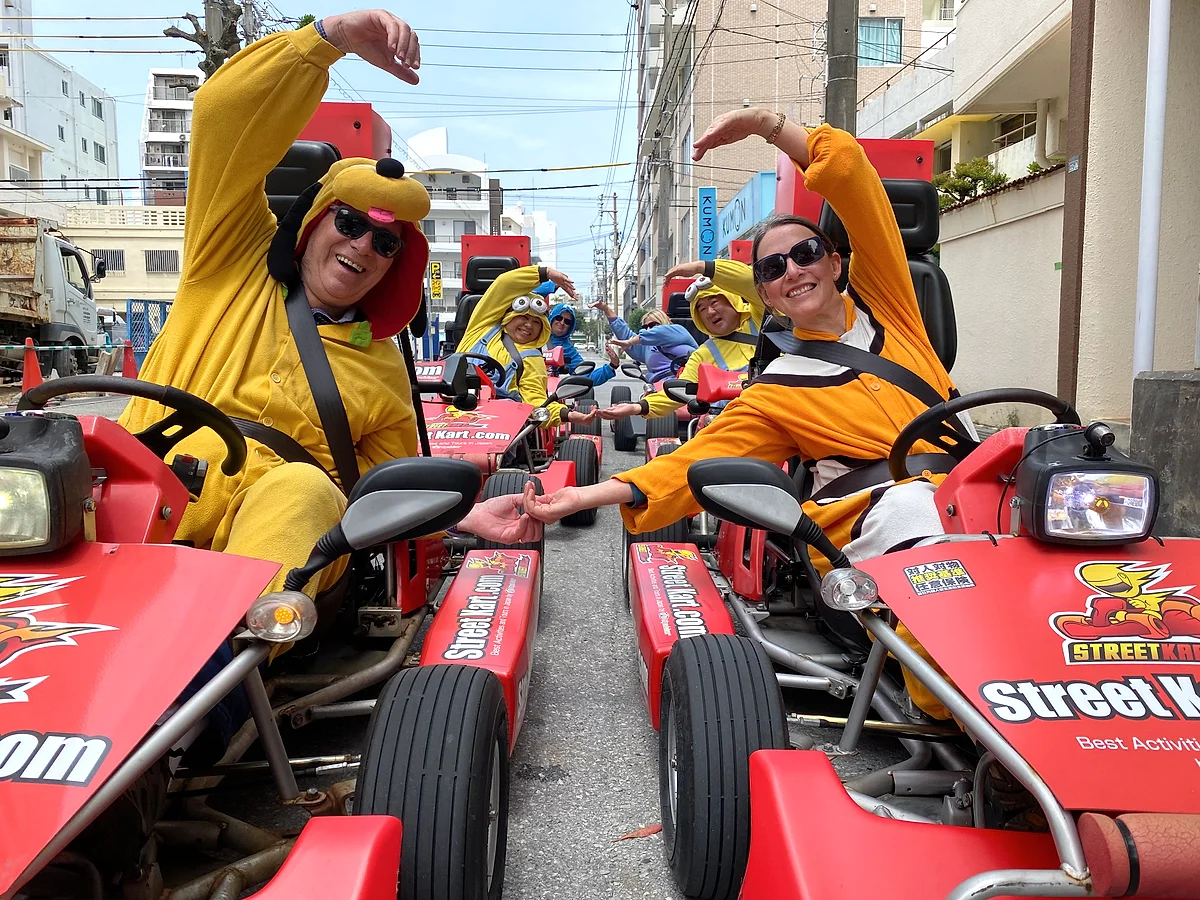
Each Street Kart location has its own tour course, and a guide leads from the front. You don't get to plan your own route, and some people will find that limiting. But if you want less to prepare, it works in your favor, because choosing the roads is the operator's job.
On a road trip, someone usually ends up as navigator in the passenger seat. They peer at the screen and call out, "Turn right up ahead." Meanwhile, outside the window, the color of the sea shifts and the shadows of the street trees slide past, and the navigator barely sees any of it. When you're following a guide in front of you, nobody has to navigate. You can keep your head up and watch the light change.
Before you set off, the staff explain how to operate the kart, the route, and the safety rules. So even without studying a map in advance, you'll hear everything you need to know right there before you take the wheel. On the road, you follow Japanese traffic rules and the guide's instructions. You follow the kart in front while watching the traffic lights and your distance from the next kart. Your attention moves off a map in your hands and onto the road in front of you.
What Do the Roads on the Tour Look Like?
The places confirmed for the Okinawa (Naha) tour are central Naha, the area around Kokusai-dori, Senagajima Island, the area around Naha Airport, and a coastal route. The operator decides the actual route, and it may change depending on conditions on the day. Check the Street Kart official website for route details.
Kokusai-dori is a main tourist street about 1.6 km long, sometimes called the "Miracle Mile." It's lined with souvenir shops, restaurants, and general-goods stores, and their storefront colors are packed in without a gap. The area around the Prefectural Office and Naha City Hall is the political and economic center of Okinawa, and the street feels a little more formal there.
On a kart, the sounds of the city come straight to your ears: sanshin music drifting from a shop, voices at a red light, the low hum of the engine coming up through your feet. On foot these sounds reach you one at a time. On a kart they run together into a single band that passes through your body. You might feel the buzz of Kokusai-dori in your back before you hear it.
That's enough about the kart itself. From here on, it's about what you'll see and where.
Senagajima is a small island south of Naha Airport. It's home to Senagajima Umikaji Terrace, a cluster of white buildings, and it's surrounded by emerald-green sea. Around Naha Airport, you can watch planes take off and land up close.
When you hear a plane coming, you'll want to look up at the sky. While you're holding the wheel, though, keep your eyes forward. The tour includes stops for photos. Save looking up at the sky for when the kart has stopped.
You go from the packed colors of Kokusai-dori to wide-open coastal views, and that shift is what makes the Naha course interesting. The shadows of the signs end, and suddenly the sky opens up. The white walls of the buildings throw back the sunlight, and for a moment you squint at the glare. After coming through streets crowded with people and shops, you'll probably remember the blue of the sea beyond them for a long time.
The coastal route keeps up the tropical scenery: blue sea, white sand beaches, rows of palm trees. How strong the sun and wind are, though, depends a lot on the season and the weather. Nobody can promise that a given time of day will be cool. Look at the sky on the day and follow the operator's guidance.
The Backstreets on Foot: Tsuboya and Ichiba-hondori Before or After the Tour
Naha's backstreets have a feel all their own, with daily life going on almost close enough to brush your shoulder. You may get closest to that walking around before or after the tour rather than during it.
To be clear up front: the places below are near the shop, not on the tour course. You'd walk them before or after your ride.
Yachimun-dori is a street in Tsuboya, Naha's pottery district. It's lined with pottery shops and cafés and still has the feel of a traditional craft neighborhood. Pottery sits on the shelves out front, and afternoon light collects on the thick rims. As the noise of the main road fades behind you, you'll find yourself walking more slowly. The street goes quiet, but you still feel the sun-warmed heat of the stone paving through the soles of your feet.
It's a 15-minute walk from the shop. Not everyone in your group will walk at the same pace. The more energetic ones can go ahead to look at pottery while the others meet them later at a café.
If you want to buy pottery, do it after the tour. There's only a little room on the kart for bags, and the lockers at the shop are meant for small items, not anything as big as a suitcase. Instead of showing up at reception holding something breakable, finish your ride, and once your hands are free, take your time deciding in front of the shelves. Walking home with the weight of your wrapped pottery on your arm is a nice way to end the day, too.
Daiichi Makishi Public Market is known as "Okinawa's kitchen." It sells local Okinawan foods, and on the second floor you can have ingredients you bought downstairs cooked for you. Ichiba-hondori is also a 10-minute walk from the shop.
The market street is full of voices and smells: fish scales glinting on ice, the sweet smell of ripe fruit, oil spitting in a fryer. You get to take your time going back over the city you zipped through on the kart, this time with your nose and ears.
How Can a Group of Different Ages and Fitness Levels Enjoy the Day Comfortably?
This is the most important part.
Each person drives their own street kart. There are no passenger seats, so don't plan on everyone in your group riding.
To drive, you need a valid driver's license, and only certain license types are accepted. There are also age requirements and other conditions. These vary by country and license type, so this article won't try to give definitive answers. Before your trip, have each person check the full requirements on the official website. It's a real shame to find out right before the trip that your license doesn't qualify.
Decide from the start who wants to drive, who will see them off, and who will meet up afterward. That way, nobody ends up arguing on the morning of the tour over who can ride and who can't.
There's only one thing to plan for the people who aren't driving: where they'll wait.
Near the shop are Kokusai-dori (a 10-minute walk), Makishi Public Market (also 10 minutes on foot), and Yachimun-dori (15 minutes on foot). Anyone who isn't confident on their feet can sit and wait in a hotel lounge or a café. Watching the condensation bead on a cold glass is part of the trip too. If you'd rather wait by the sea, Naminoue Beach is a 20-minute walk from the shop. Naminoue Shrine is right next to it, so you can visit the shrine and then walk down to the beach.
If you'd like to spend longer exploring, Shuri Castle is a 20-minute drive away. It was the royal palace of the Ryukyu Kingdom and is a World Heritage Site. It's still being rebuilt after the 2019 fire, and you can see the Shureimon Gate and the site of the Seiden (main hall). Because it's 20 minutes away by car, though, treat it as something to plan for another day rather than a quick trip while you wait.
Not everyone has to do the same thing. If you all end up around the same table at the end of the day, it was a good day. The people who rode the karts describe how clear that green sea was. The ones who waited set out what they found at the market. With one more thing to talk about, dinner goes on a little longer.
What Prep You Can Skip, and What You Can't
What you can skip
Route research and navigation. Each shop has its own course, and a guide leads the way. You probably won't use any route you studied in advance.
Looking for parking at the shop. None of the shops have parking, and they recommend coming by public transportation. Even if you're getting around Okinawa by rental car, leave it at your hotel for the day. Then you won't have to look for parking at all.
As for language on the day, don't bother studying. Just check what to expect. Tour guidance is mainly in English. Japanese or other languages depend on the staff working that day and aren't guaranteed. The official website is available in 22 languages, but that applies only to the website, not to the guidance on the tour. If anyone in your group is worried about the language, check the official website before you go.
What you can't skip
Checking each person's license and eligibility. As covered in the previous section, this is the one thing worth spending time on.
Booking early. Weekends tend to fill up, so booking early is recommended. If you want to ride on a weekend, book as soon as your travel plans are settled. Check the official website for how to book and how to get in touch.
Checking the weather and what to wear. Sun and rain in Okinawa vary a lot by season. Check the official website for how weather affects whether tours run and what to wear on the day. If you're going swimming before the tour, leave time to shower and change so you're not rushed. Salt left on your skin can bother you more than you'd expect until you change.
For reference, Street Kart's guidelines recommend closed-toe shoes (sneakers, for example) and clothes that are easy to move in. They ask you to avoid open-toed shoes, heels, skirts, and dresses. In Okinawa it's tempting to wear beach sandals everywhere, but switch to proper shoes for this day. For rain, the guidelines say tours go ahead as planned in light to moderate rain, with raincoats provided, and are canceled in heavy rain or typhoons. Check the official website before you go for the latest policy.
Focus on driving while you drive. We understand wanting to take photos of the scenery. Even so, don't hold your phone while driving. Follow your guide's instructions about taking photos. You're sharing the road with other vehicles, so safety comes before fun.
Prepare Less, and Spend the Time You Save Enjoying Naha
You don't need to plan a route. You don't need to look for parking. You don't need to study directions.
The only things you can't skip are checking each person's license and eligibility, booking early, and checking the weather. Once those are done, all that's left is to follow the guide out front and go see the colors of Kokusai-dori and the sea around Senagajima. The people who aren't driving wait among the voices of the market, and after the tour, everyone walks together down the street in Tsuboya lined with pottery. That's where the time you saved on prep can go.
By evening, as the light that had collected on the rims of the pottery slowly slants away, the smell of the sea breeze in your hair will have mostly faded. Even so, the low hum of the engine will stay with you for a while.
For participation requirements and the latest information, check the Street Kart official website. If you want to ride on a weekend, get in touch as soon as your itinerary is set.
This article was originally written in Japanese and translated using AI. Some expressions may read unnaturally, and we appreciate your understanding. For the most accurate and up-to-date information, please refer to the official site at kart.st.
Street Kart is not affiliated with Nintendo or the Mario Kart series in any way. We do not provide costumes of Nintendo characters, and such costumes may not be worn during tours even if brought by participants.